01What are black holes?
When people think of black holes, they picture them to be some sort of huge, heavy vacuum cleaners sucking in everything in the universe. However, the reality is quite different!
A black hole is simply a region in space where gravity is so incredibly strong that nothing (not even light) can escape its pull. It doesn't hunt down objects; rather, things have to get too close and cross a specific threshold distance to be affected.
Black holes are remnants of stars. They are celestial objects with huge mass that are formed by a core collapse (when nuclear fuel runs out, outward pressure drops and gravity rapidly crushes the iron core inward), ultimately resulting in a supernova explosion.
There are also primordial black holes. In the early moments after the Big Bang, during the rapid expansion of the universe, tiny quantum fluctuations led to the creation of “tiny pockets” where density was highly concentrated. When the internal gravity of these highly dense pockets surpassed the external radiation pressure, they collapsed straight into black holes. So, they formed from early cosmic material rather than the general stellar collapse cases we previously discussed.
Most supermassive black holes are theorized to have emerged from direct collapses of primordial gas clouds or rapid gas accelerations in the early universe (pristine masses of gas left over from the Big Bang that contain only the simplest and lightest elements in the universe). Dust clouds, nearby stars, and sometimes even galaxies contribute to the growth of these humongous beasts!
02The anatomy
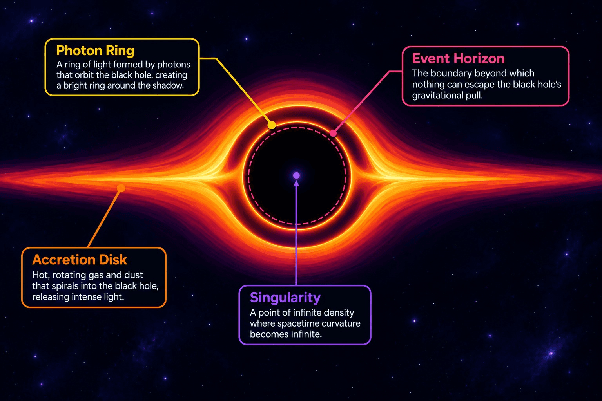
To understand a black hole, we look at its main structural parts:
- The Event Horizon: This is the boundary or the “point of no return.” Once anything crosses this line, it cannot escape the black hole's gravitational pull. This point is located at the Schwarzschild radius.
- The Singularity: Located right at the center, this is a point where matter is crushed down to infinite density, and the normal laws of physics stop working.
- The Accretion Disk: A swirling, superheated ring of gas, dust, and debris spinning rapidly around the event horizon before falling in, often glowing brightly in X-rays and visible light.
- The Photon Sphere: A region just outside the event horizon where gravity is so strong that photons (particles of light) are forced to travel in orbits.
03General relativity
To explain why black holes exist, we look to Albert Einstein. Before Einstein, Isaac Newton taught us that gravity is an invisible force pulling objects together. Einstein changed everything with his General Theory of Relativity, proposing that space and time are fused together into a single fabric called spacetime.
Heavy objects like stars, planets, and black holes warp this fabric, causing it to bend. Think of placing a heavy bowling ball in the middle of a stretched-out trampoline: it creates a deep dip. The Einstein field equations mathematically describe this exact relationship:
In simple terms, this equation shows that the distribution of mass and energy () dictates how the geometry of spacetime curves (). Near a black hole, that curve becomes an infinite drop, creating a profound gravitational well that dictates the behavior of everything around it and warps time itself as we know it.
04Bridging general relativity to gravitational time dilation
We are now stepping into the advanced logic surrounding the mystery of the behaviour of time near a black hole. For this, we must first understand the meaning and necessity of the Einstein field equations.
The Einstein field equations are a set of ten interconnected equations in Albert Einstein's general theory of relativity that show how matter and energy shape the geometry of space and time.
They provide the foundational geometry of spacetime, but to see how time dilation actually happens, physicists look to a specific solution of these equations known as the Schwarzschild metric.
While the full field equations balance mass-energy with spacetime curvature, the resulting metric gives us a precise mathematical description of how space and time are distorted around a non-rotating mass like a black hole. This leads directly to the formula for gravitational time dilation:
- is the proper time experienced by an observer close to the black hole (experiencing intense gravity).
- is the coordinate time measured by a distant observer far away from the gravitational field.
- is the mass of the black hole.
- is the radial distance from the center of the black hole.
- is the Schwarzschild radius (the radius of the event horizon, as discussed earlier).
If we attempt to present this information graphically, we observe the following:
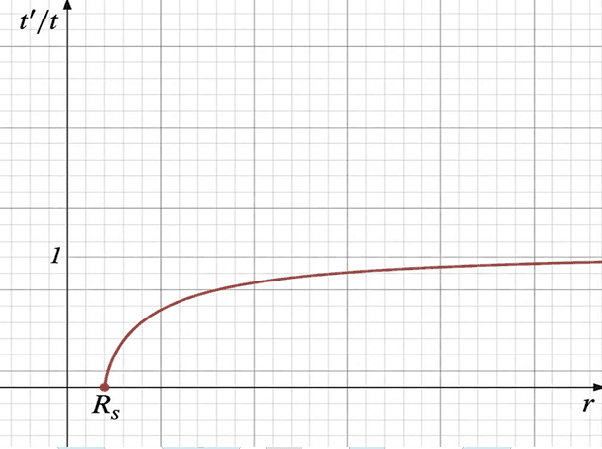
The above is a direct plot obtained from the gravitational time dilation formula. It gives us an easy way to move between x and y values and find the variables in the equation without having to solve any calculations.
What this equation means in plain English
- As an observer or a clock gets closer and closer to the event horizon ( approaches ), the value inside the square root gets closer to zero. In the graph, we notice that as the radius tends to , the time dilation factor bends down from 1 towards 0.
- Right at the event horizon (), time effectively freezes relative to a distant observer, forming the bridge between Einstein's geometric universe and the mind-bending reality of black hole mechanics. In the graph, we notice that at , the time dilation factor touches 0.
To put it in a more practical sense, imagine two people, A and B, on a mission to analyse time dilation near a black hole. B stays on Earth and observes what time looks like for both of them as A travels closer to the black hole. We would observe the following:
- A observes no change in time at all throughout the entire process.
- B observes that time for A gets slower and slower as A gets nearer to the black hole. At the instant A reaches the event horizon (the Schwarzschild radius), time for A stops completely as observed from B's perspective.
05The singularity: where physics breaks down
Imagine taking the mass of several massive stars, compressing them together, and shrinking them down until they fit inside a single grain of sand, or something even smaller. The result is a point of almost zero volume and infinite density. This is not science fiction; it is the mind-bending reality of a gravitational singularity, one of the most profound and perplexing concepts in modern astrophysics.
What is a singularity?
A singularity is a point, a coordinate, in 3-dimensional space where matter is crushed into an infinitely small space. Because a singularity is a point, it has zero volume and thus an infinite density (density = mass / volume, and here the volume is zero, so the density grows without limit).
Due to these traits, singularities break through the barriers of physics as we know it and wander into territory still unknown to us. Because the math yields infinity, the physics of singularities raises a lot of questions that we are yet to begin answering.
In actuality, even the grain of sand analogy is not enough to capture the oddity of singularities, since even a single grain is infinitely bigger than a singularity. Why is that? A singularity does not have any physical dimensions or extent in the three spatial dimensions.
Types of singularities
There are two main types of singularities:
- The Center of the Abyss: At the very center of a black hole lies a gravitational singularity. However, defining the exact moment an event horizon forms comes with a fascinating theoretical paradox. Interested readers are encouraged to research the Oppenheimer–Snyder model of gravitational collapse for more on the teleological paradoxes related to it.
- The Dawn of the Universe: On a grander scale, modern cosmology suggests that the entire universe began as a primordial singularity. Before the Big Bang, all space, time, matter, and energy were condensed into a single, infinitely dense point. This is what is known as the primordial singularity.